The Complete Guide to Basement Waterproofing in St. Louis: What Works & What Doesn’t
Basement water intrusion is one of the most common problems St. Louis homeowners face, and one of the most misunderstood.

Basement water intrusion is one of the most common problems St. Louis homeowners face, and one of the most misunderstood. The clay-heavy soil, the seasonal shrink-swell cycle, the intense spring and fall rains — all of it creates a moisture environment that is more demanding than most parts of the country. So does the age of the housing stock: a large percentage of St. Louis metro homes were built before modern waterproofing standards existed.
This guide covers the full picture: the three causes of basement water, the main waterproofing approaches and when each is appropriate, what a proper repair actually involves, what warranties mean and what they don’t, and the questions every homeowner should ask before signing anything. The goal is to give you enough information to make a confident decision — whether that decision is to call someone, to wait and monitor, or to move forward with a specific repair.
The three causes of basement water in St. Louis
Most basement water problems fall into one of three categories. Diagnosing correctly is the most important step in the process, because the wrong diagnosis leads to the wrong repair — and a repair that does not address the actual cause will not hold.
1. Hydrostatic pressure
Hydrostatic pressure is the force exerted by water in saturated soil pressing against the foundation wall and floor. When the soil around a foundation becomes saturated — during heavy spring rains, after the first significant fall storms, or during prolonged wet periods — that pressure builds until it finds the path of least resistance into the basement. The floor-wall joint, cracks in the wall, tie rod holes, and the cove joint are the most common entry points.
This is the most common cause of water intrusion in St. Louis basements. It requires a drainage solution — either interior perimeter drainage, exterior drainage, or both — to manage the water at the point where it enters the wall assembly.
2. Surface water intrusion
Surface water intrusion occurs when rainwater is directed toward the foundation by grading, downspout placement, or window well drainage failures, and enters the basement through gaps, cracks, or window frames rather than through the wall under pressure. The entry points are similar to hydrostatic intrusion, but the mechanism is different. Surface water intrusion is often solvable with drainage improvements, downspout extensions, and window well maintenance before any structural waterproofing is required.
3. Condensation
Condensation occurs when warm, humid air contacts cooler basement surfaces and the moisture in the air drops out onto those surfaces. In a St. Louis summer, where outdoor relative humidity is consistently high, an uninsulated basement wall can sustain condensation continuously. The EPA’s guidance on moisture control notes that water in the basement can result from a flow of humid air toward cool surfaces as well as from direct water intrusion. Condensation is not a waterproofing problem — it is an insulation and humidity control problem, and it requires a different solution.
A professional inspection distinguishes between these three causes. Treating condensation with an interior drainage system wastes money and does not solve the problem. Treating hydrostatic intrusion with a dehumidifier does not solve it either.
Interior waterproofing: what it is and when it’s appropriate
Interior waterproofing does not prevent water from entering the wall, it manages water after it enters the wall assembly, intercepting it before it reaches the basement floor and routing it to a sump pump for removal. The Department of Energy’s guidance on moisture control notes that the best approach for preventing moisture problems depends on local climate, type of insulation, and style of construction. For St. Louis’s clay soil and mixed-humid climate, interior drainage is typically the most practical and cost-effective primary approach for most existing homes.
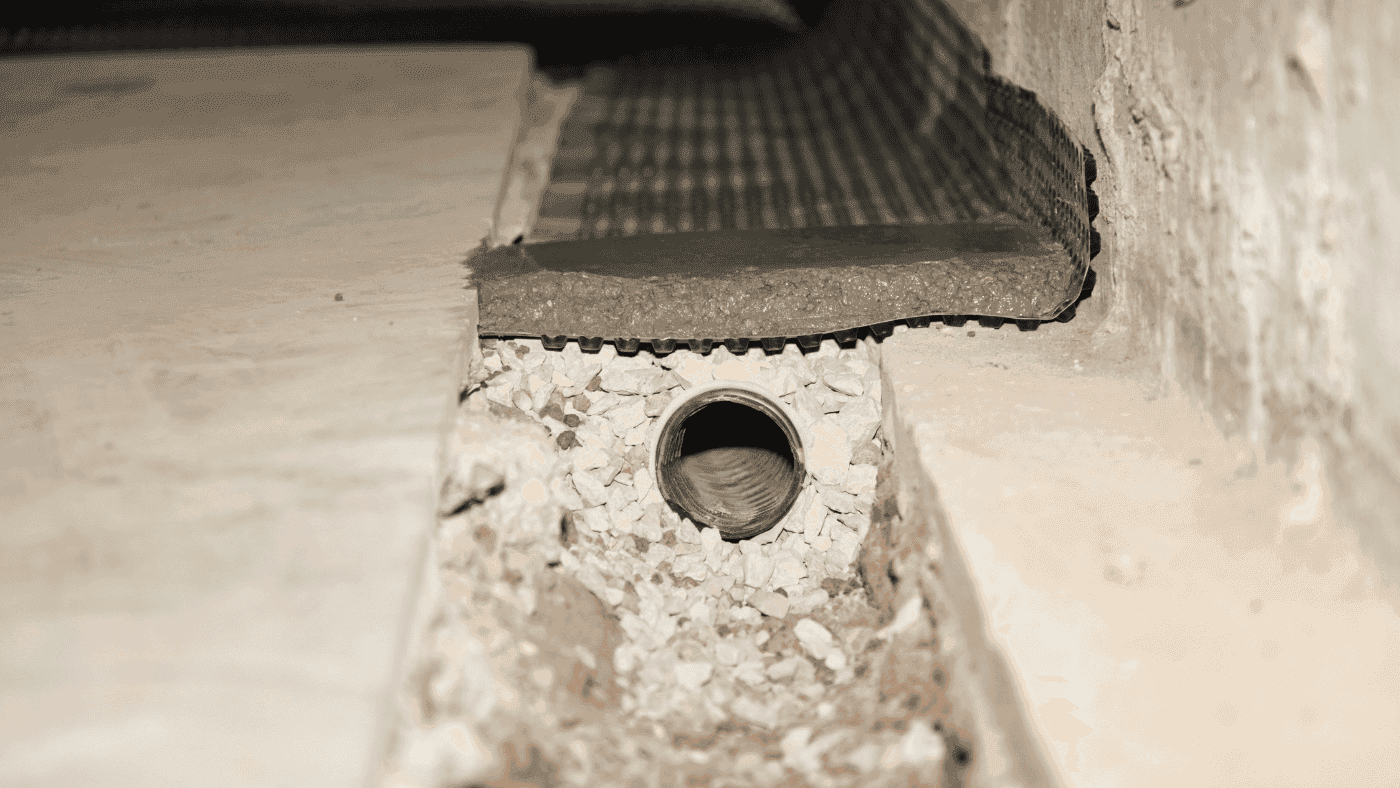
A properly installed interior system involves removing a strip of the basement floor along the perimeter, installing a perforated drain channel at the base of the wall, backfilling with gravel, and connecting the system to a sump pit and pump. The water that would otherwise spread across the basement floor is captured at the wall and removed before it causes damage.
Interior waterproofing is appropriate when: the foundation cannot be practically excavated (the most common situation in existing homes), when the source of water is hydrostatic pressure through the wall or floor-wall joint, and when a reliable drainage and pumping system is the goal. It is the approach most St. Louis waterproofing contractors, including Quality Waterproofing + Insulation, use as the primary solution for residential basements.
Exterior waterproofing: what it is and when it’s appropriate
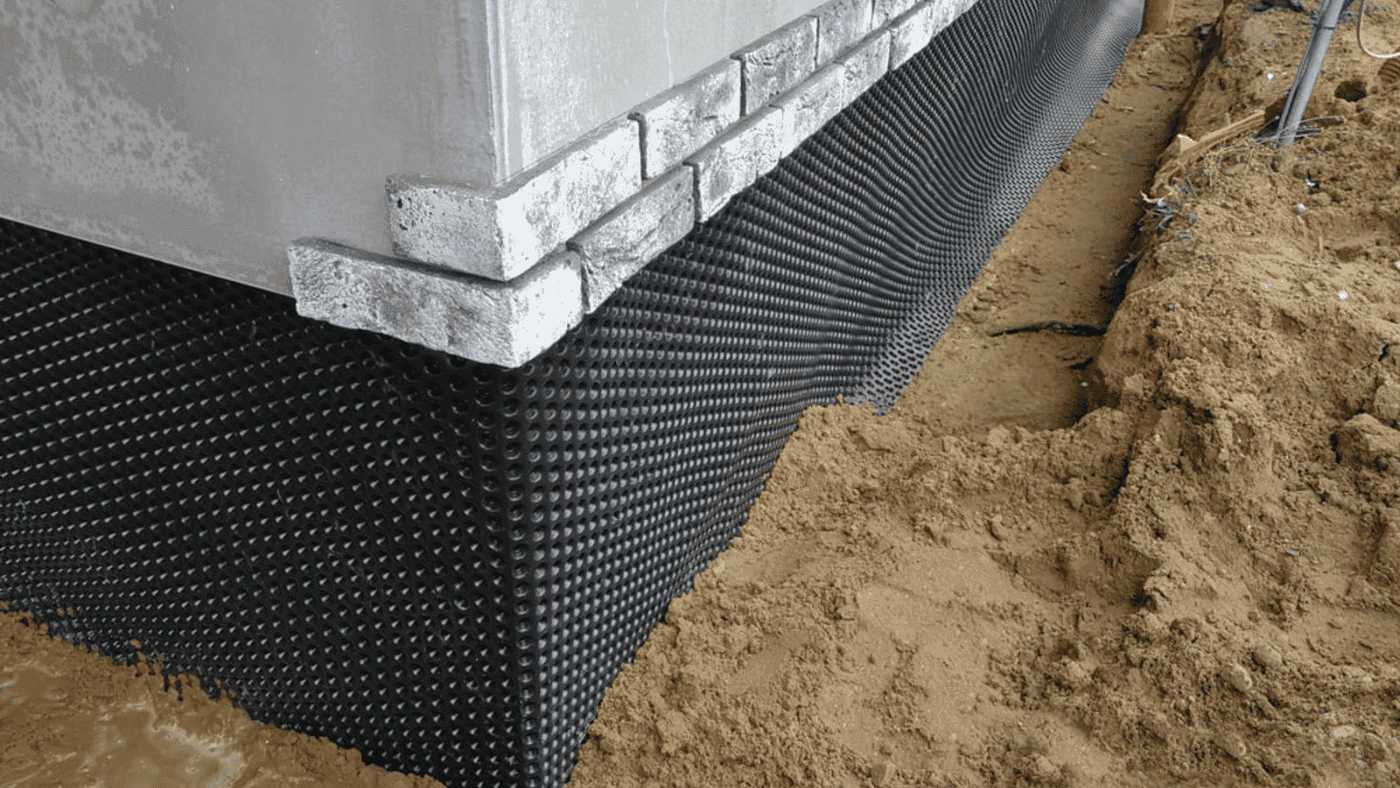
Exterior waterproofing addresses water before it enters the wall. It involves excavating around the foundation to expose the exterior face of the wall, applying a waterproof membrane or coating to that surface, installing drainage board and a footing drain, and backfilling with drainage-appropriate material. Done correctly, it creates a barrier that prevents water from reaching the wall in the first place.
Exterior waterproofing is most appropriate for new construction, where the foundation is accessible before backfill, and for specific situations in existing homes where the exterior wall face needs to be addressed, such as when a wall is failing structurally and requires exterior work regardless. It is significantly more expensive and disruptive than interior waterproofing in an existing home because of the excavation required.
For most existing St. Louis homes with chronic moisture intrusion, interior drainage is the more practical solution. Exterior waterproofing is not inherently better than interior waterproofing for an existing home, it is simply a different approach to a different part of the problem, and its value depends on the specific conditions.
Crack injection and targeted repairs
Not every wet basement requires a full drainage system. Foundation crack repair through epoxy or polyurethane injection is appropriate when a single crack or a small number of cracks are the identifiable source of water intrusion and the surrounding wall is otherwise sound. Crack injection fills the crack from the inside and prevents water from passing through. It does not address hydrostatic pressure on the wall as a whole, if the wall is under significant pressure, other cracks may develop over time even after the injected crack is sealed.
The distinction matters because crack injection is substantially less expensive than a perimeter drainage system. A professional inspection identifies whether crack injection is appropriate or whether the source of water is more systemic.
Sump pumps: the critical component on which every system depends
An interior drainage system is only as effective as the sump pump it routes water to. A properly sized pump with a functioning float, a clear discharge line, and a tested battery backup is the final line of defense in every interior waterproofing system. A drainage system that routes water to a failed or undersized pump does not protect the basement.
When evaluating an interior waterproofing proposal, confirm that the sump pump is included in the system design, that it is appropriately sized for the drainage load, and that a battery backup is included or recommended. A power outage during a heavy storm, which is common in St. Louis, is exactly when a backup is needed most.
What waterproofing warranties actually cover and what to ask
Waterproofing warranties vary significantly between contractors, and reading them carefully before signing matters. Here are the most important questions to ask about any warranty:
Is it a lifetime warranty or a limited-term warranty? A lifetime warranty on an interior drainage system typically means the drainage system itself is warranted against failure, not against all future water entry under any conditions. Understand what specifically triggers a warranty claim.
Is the warranty transferable to a new owner? A transferable warranty adds real value when selling the home. A non-transferable warranty does not. Ask specifically whether the warranty transfers and under what conditions.
What does the warranty require of the homeowner? Most warranties require that the sump pump be maintained and that the system not be altered. If the pump fails and the basement floods, a warranty that requires pump maintenance may not cover the damage. Understand the maintenance obligations.
Who backs the warranty? A warranty from a company that no longer exists cannot be honored. Quality Waterproofing + Insulation has been operating in St. Louis since 1955. We offer a lifetime warranty on our interior waterproofing system, and it is transferable to future owners.
How much does basement waterproofing cost in St. Louis?
Cost varies significantly based on the linear footage of the basement perimeter, the condition of the existing floor and wall, the depth of the basement, whether crack repair work is needed, and whether the sump pit needs to be installed or upgraded. Providing a specific range without seeing the basement is not useful and any contractor who quotes a precise price without an inspection has not done the diagnosis.
What is consistent: interior perimeter drainage systems in St. Louis typically range from a few thousand dollars for a small partial system to significantly more for a full perimeter installation in a larger home. The cost of waiting, if water intrusion leads to mold remediation, structural repair, or damage to finished space, consistently exceeds the cost of addressing the system that would have prevented it.
What to expect from a Quality Waterproofing + Insulation inspection
Our inspection process is free, and it starts with understanding what you have seen — where the water appears, when it appears, and what you have already tried. We then walk the basement to identify the entry points, assess the wall condition, evaluate any existing drainage or sump components, and look for factors outside the basement (grading, downspouts, window wells) that may be contributing. The EPA notes that fixing the water problem is always the first step — before any mold remediation, finishing work, or other basement improvement. Our inspection identifies what the water problem actually is and what it will take to fix it.
We do not recommend the most expensive solution by default. If crack injection is appropriate, we say so. If the grading and downspouts are the likely cause and a drainage system is premature, we say that too. Our goal is a dry basement, not a system sale.
Quality Waterproofing + Insulation has been waterproofing St. Louis basements since 1955. We serve homeowners throughout St. Louis County, St. Charles County, Jefferson County, and Metro East, from Chesterfield and Kirkwood to O’Fallon and Belleville. To schedule a free inspection, visit qualitywaterproofing.com/contact.
Ready to get a straight answer about your basement? Schedule a free inspection here.
Read more articles
18 Jul 2024
The Cost of Ignoring Basement Waterproofing
If you skip out on waterproofing it, you might be setting yourself up for some serious headaches.

18 Jul 2024
5 Common Signs of Foundation Problems
Your home's foundation is like the backbone of the entire structure—it keeps everything standing strong and steady.
18 Jul 2024
5 Signs Your Basement Needs Waterproofing
Basements tend to be the first to feel the effects of unwanted water, and that can lead to all kinds of headaches.